How to read odds and implied probability for EV betting

Every sportsbook line is a probability statement disguised as a price.
When odds show 1.85, +140, or 4/1, most people only see payout. EV bettors read something else: the implied chance of an outcome. That is why learning how to read betting odds probability is the first skill required for EV betting.
Most bettors stop at payout. EV bettors translate the number.
If you cannot read odds as probability, you cannot evaluate whether a bet has value. And if you cannot evaluate value, expected value (EV) becomes guesswork.
This guide shows how to read odds the right way, how to convert odds to probability across formats, and how to apply odds implied probability EV logic in a repeatable workflow.
What Are You Actually Reading When You Look at Odds?
Odds are not predictions. They are prices.
A sportsbook sets odds to reflect likelihood, manage risk, and collect margin. That means odds communicate three things at once:
- The implied probability of an outcome
- The payout offered for taking that risk
- The bookmaker’s built-in edge
So “reading odds” is not just understanding what you win. It is understanding what chance the market is pricing. If the line shortens, implied probability increases. If the line gets longer, implied probability decreases.
This is why how to read betting odds probability is an EV skill, not a trivia skill. EV betting does not start with “who wins?” It starts with “what probability is this price implying?”
Once you see odds as a probability language, the next step is translation.
How to Convert Odds to Probability (Decimal, American, Fractional)
To apply odds implied probability EV analysis, you must be able to convert odds to probability quickly and correctly.
Decimal Odds
Decimal odds are the simplest format to interpret because they already include your total return (stake + profit).
To convert decimal odds into implied probability, use:
Implied Probability = 1 ÷ Decimal Odds
Examples:
- 2.00 → 50%
- 1.80 → 55.56%
- 2.50 → 40%
- 3.00 → 33.33%
When you see 2.00, the sportsbook is pricing the outcome as a 50% chance. When you see 1.80, it implies the event is expected to happen more often, about 55.56% of the time.
Decimal odds are preferred in EV betting because they convert directly into implied probability with one simple calculation.
American Odds
American odds express profit relative to a $100 base stake, which makes the conversion slightly different depending on whether the number is positive or negative.
Positive odds (e.g., +150): These represent underdogs. The number shows how much profit you would earn on a $100 stake.
Probability = 100 ÷ (Odds + 100)
- +150 → 40%
- +200 → 33.33%
Negative odds (e.g., -150):
These represent favorites. The number shows how much you must stake to win $100.
Probability = |Odds| ÷ (|Odds| + 100)
- -150 → 60%
- -200 → 66.67%
Once converted, American odds function exactly the same as decimal odds for EV comparison, they simply require one extra step.
Fractional Odds
Fractional odds show profit relative to stake. For example, 5/2 means you win 5 units for every 2 units staked.
To convert fractional odds into probability:
Probability = Denominator ÷ (Numerator + Denominator)
- 5/2 → 28.57%
- 3/1 → 25%
This tells you how often the outcome must occur to justify that payout level.
How Should You Interpret Implied Probability?
After you convert odds into implied probability, you still need to interpret what the number means.
If a line implies 60%, it suggests the sportsbook is pricing the outcome as if it occurs roughly 6 out of 10 times. That does not mean the outcome is “safe.” It means the payout is priced around that probability level.
Two interpretation points matter in how to read betting odds probability correctly:
1) Small Changes In Odds Can Mean Big Probability Shifts
A move from 2.10 to 1.95 looks small. In probability terms it is meaningful:
- 2.10 → 47.62%
- 1.95 → 51.28%
That is a noticeable shift in implied probability, and shifts like this often decide whether a bet is priced fairly.
2) Odds Movement Is Probability Updating In Real Time
Odds shorten when the market prices an outcome as more likely. Odds drift when the market prices it as less likely. This is why reading odds is also reading the market’s probability update.
This interpretation layer prevents EV errors caused by reading odds as fixed truth.
Why Implied Probability Is Inflated by Margin
Implied probability is rarely “clean.” It includes the bookmaker’s built-in margin.
In many two-sided markets, the implied probabilities across both outcomes add up to more than 100%. That excess is called the overround, and it represents the sportsbook’s edge.
For example:
Two-sided market at 1.91 / 1.91
Implied probability for each side:
1 ÷ 1.91 = 52.38%
Combined total:
52.38% + 52.38% = 104.76%
The extra 4.76% is the bookmaker’s margin.
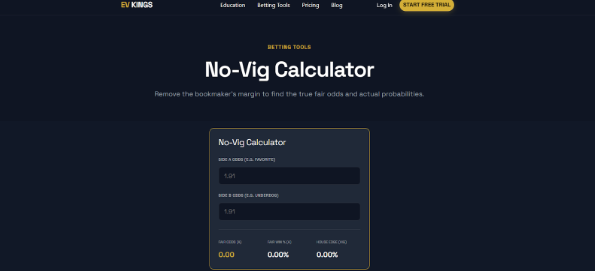
You can see this clearly in the No-Vig Calculator example shown above. When both sides are priced at 1.91, the tool calculates:
- Fair Odds (A): 2.00
- Fair Win % (A): 50.00%
- House Edge (Vig): 4.71%
This shows that while the sportsbook is pricing each side as 52.38%, the true fair probability, after removing margin, is 50%.
For odds implied probability EV analysis, this distinction is critical. If you compare your estimated probability to an inflated 52.38% instead of the fair 50%, you may wrongly conclude there is no value, or worse, think a negative-EV bet is profitable.
Before evaluating EV, you must separate probability from margin.
How to Read Odds for EV Betting
Reading odds for EV betting is not about memorizing formulas. It is about following a consistent probability comparison process.
Here is the structured method that ties everything together:
Step 1: Start With the Price
Identify the odds format (decimal, American, or fractional). Before thinking about value, understand exactly what price the sportsbook is offering.
Step 2: Translate the Price Into Implied Probability
Convert the odds into percentage form. This number represents the probability the sportsbook is pricing into the market.
If the odds are 2.20, the implied probability is:
1 ÷ 2.20 = 45.45%
Now you know the bookmaker is pricing the outcome as if it happens roughly 45% of the time.
Step 3: Adjust for Margin If Necessary
If you are analyzing a two-sided market, check whether the total implied probabilities exceed 100%. If they do, remove the margin to understand the fair probability baseline.
This step ensures you are comparing clean probabilities rather than inflated ones.
Step 4: Form Your Independent Probability Estimate
Using data, modeling, market benchmarks, or analytical tools, determine your own probability estimate.
Suppose your analysis suggests the outcome wins 50% of the time.
Step 5: Compare the Two Numbers
Now compare:
- Market implied probability: 45.45%
- Your estimated probability: 50%
The sportsbook is pricing the event as less likely than your model suggests.
Step 6: Evaluate the Probability Gap
The difference is:
50% – 45.45% = 4.55 percentage points
That gap is the foundation of odds implied probability EV logic.
You are not predicting the outcome with certainty. You are identifying a price that pays as if the event occurs 45% of the time, while your analysis indicates it occurs 50% of the time.
Over a large sample, consistently taking positions where your probability exceeds implied probability is what creates positive expected value.
That is the practical answer to how to read betting odds probability for EV betting, not guessing winners, but systematically comparing probabilities.
Common Errors When Reading Betting Odds Probability
Most EV mistakes start before EV calculation even begins.
- Mistaking payout for value: A bigger payout is not value unless probability is underpriced.
- Ignoring margin: Overround inflates implied probability and distorts comparisons.
- Mixing formats: Failing to correctly convert odds to probability leads to wrong conclusions.
- Overreacting to movement: Not every move signals a true probability shift, especially in low-liquidity markets.
Reading odds correctly prevents these errors upstream.
Probability First, EV Second
Odds are probability expressed as price. EV betting begins when you translate that price into implied probability and compare it to an independent estimate.
To do that reliably, you must be able to:
- convert odds to probability
- interpret how probability shifts with odds movement
- account for margin inflation
- apply the EV workflow consistently
Bettors who want to handle probability conversion, remove margin correctly, and track EV decisions in a structured way can use EV Kings to centralize the entire process. Instead of juggling spreadsheets and manual calculations, the platform keeps probability, pricing, and edge evaluation aligned in one consistent workflow.
Before calculating edge, make sure the odds are being read correctly.