Expected Value in Sports Betting: How EV Is Calculated

Most bettors think in outcomes. They ask, “Will this team win?” or “Is this a good pick?”
Professional bettors ask a different question: “Is this price profitable over time?”
That difference defines long-term success.
Expected Value (EV) in sports betting is not about predicting a single result. It measures whether the odds offered by a sportsbook are mathematically favorable in the long run. You can win a bet that has negative EV. You can lose a bet that has positive EV. The result of one event does not determine whether the bet was profitable in theory.
Understanding EV in sports betting requires clarity about probability, odds conversion, and margin removal. This guide breaks down how to calculate EV bets step by step, explains what the numbers truly mean, and shows how structured analysis replaces guesswork. Once you can calculate EV, the next skill is finding positive EV bets in live markets.
What Is EV in Sports Betting?
Expected Value (EV) is a statistical measurement of the average return you can expect per bet if the same wager were repeated many times.
In sports betting, EV answers a single question: Does the payout justify the probability?
A bet has positive EV when the potential return exceeds the true probability of the outcome. It has negative EV when the payout is lower than what the probability justifies.
For example: If a coin flip has a true 50% chance of landing heads, fair decimal odds would be 2.00. If a sportsbook offers 1.90, the payout is lower than fair value. That bet carries negative EV.
If instead the odds offered are 2.20, the payout exceeds fair value. That bet carries positive EV.
EV does not predict short-term outcomes. It measures long-term expectation. Over one event, anything can happen. Over hundreds or thousands of similar bets, the mathematical edge becomes visible.
This is why EV in sports betting determines sustainability. Without positive expected value, losses compound over time due to the bookmaker’s margin.
How Do Odds Translate Into Probability?
To calculate EV bets correctly, you must first understand how odds convert into implied probability.
For decimal odds, the formula is simple:
Implied Probability = 1 ÷ Decimal Odds
Examples:
- Odds 2.00 → 1 ÷ 2.00 = 50%
- Odds 1.91 → 1 ÷ 1.91 = 52.38%
- Odds 3.00 → 1 ÷ 3.00 = 33.33%
This implied probability represents what the sportsbook suggests the chance of the event is.
However, sportsbooks include a built-in margin. That means the combined implied probabilities for all outcomes typically exceed 100%.
For example:
Two-sided market at 1.91 / 1.91:
- Side A: 52.38%
- Side B: 52.38%
- Total: 104.76%
The extra 4.76% represents the bookmaker’s edge.
Understanding implied probability is the foundation of calculating EV accurately.
How to Calculate EV Bets Step by Step
Now we move to the core calculation.
The formula for expected value in decimal format is:
EV = (True Probability × Decimal Odds) − 1
Let’s walk through a full example.
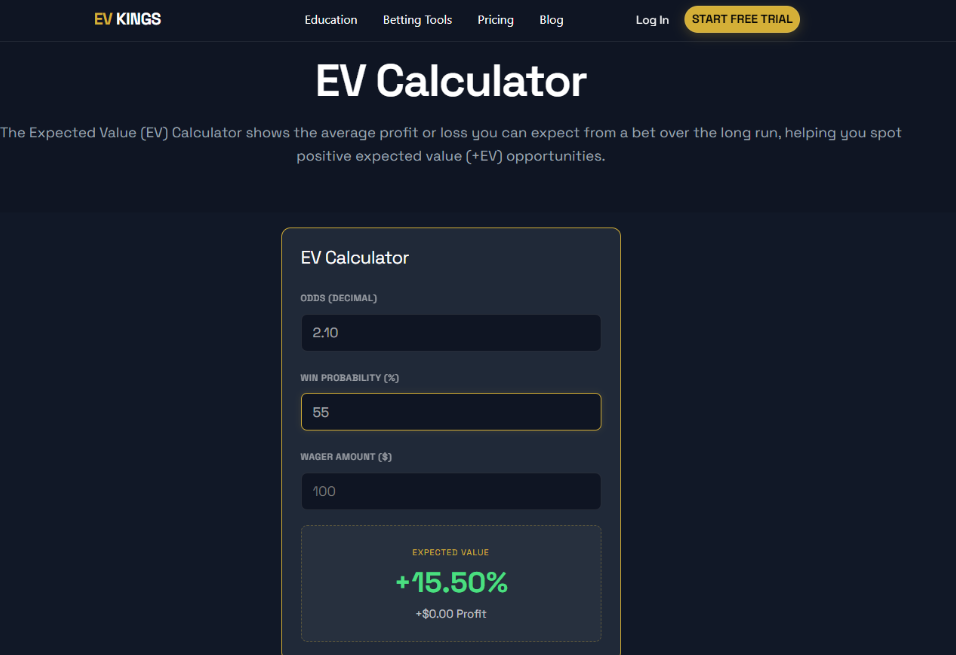
Step 1: Estimate True Probability
Suppose your analysis suggests an outcome has a 55% chance of occurring.
Step 2: Identify the Offered Odds
The sportsbook offers decimal odds of 2.10.
Step 3: Apply the EV Formula
EV = (0.55 × 2.10) − 1
EV = 1.155 − 1
EV = 0.155
This equals 15.5%.
Step 4: Interpret the Result
An EV of 0.155 means you have a 15.5% expected return per dollar wagered.
If you consistently placed $100 bets with this same edge, the theoretical long-term average profit would be $15.50 per bet over a large sample.
That does not mean you win 15.5% of the time. It means your expected return per dollar is positive.
The strength of EV in sports betting lies in repetition. The formula does not guarantee outcomes, it guarantees expectation.
Why Removing the Vig Is Essential Before Calculating EV
A common mistake when learning how to calculate EV bets is ignoring the bookmaker’s margin.
Because sportsbooks inflate implied probabilities, you must remove the vig to estimate fair probability.
Consider a market priced at:
1.91 / 1.91
Each side implies 52.38%. Combined, that equals 104.76%.
To find the no-vig probability:
- Add both implied probabilities (104.76%).
- Divide each side’s implied probability by the total.
52.38 ÷ 104.76 ≈ 50%
After removing the vig, the true fair probability returns to 50%.
Failing to remove the margin leads to incorrect probability assumptions, which distorts EV calculations.
Accurate EV calculation depends on using fair probabilities, not inflated ones.
What Does EV Percentage Actually Mean?
Many bettors misunderstand EV percentage.
A 5% EV does not mean:
- A 5% win rate
- A guaranteed 5% profit
- A guaranteed result in the short term
EV percentage represents expected return per unit risked.
If a bet has 5% EV and you wager $1,000 repeatedly under identical conditions, the long-term theoretical average profit is $50 per bet.
But short-term variance can create temporary losses.
This is why sample size matters. A positive EV strategy may still produce losing weeks or months. The edge emerges over sufficient volume.
How Does Stake Size Affect Expected Value?
EV is calculated per dollar wagered. That means total expected profit scales with stake size.
Example:
If EV = 10%
- $100 bet → $10 expected profit
- $1,000 bet → $100 expected profit
However, increasing stake size also increases variance exposure.
Many advanced bettors use structured bankroll management systems to balance growth and risk. While the EV formula itself does not change with stake size, total volatility does.
If stake size is too aggressive relative to bankroll, even positive EV can lead to unsustainable drawdowns.
This is why understanding how to calculate EV bets is only part of the process. Execution discipline determines survival.
Common Mistakes When Calculating EV in Sports Betting
Several errors repeatedly undermine EV-based betting.
1. Confusing Implied Probability With True Probability
Implied probability comes directly from sportsbook odds. True probability must come from independent analysis.
If odds imply 55%, that does not mean the real chance is 55%. It simply reflects how the bookmaker priced the market. EV only exists when your estimated probability differs from the implied one.
2. Ignoring the Vig
Sportsbooks build margin into every market. In a two-sided market, implied probabilities often exceed 100%.
If you fail to remove this margin before calculating EV, your probability baseline is inflated. That distortion can turn a negative EV bet into a falsely perceived positive one.
3. Overestimating Edge
EV is highly sensitive to probability estimates. A 2–3% error in true probability can completely change the expected value result.
Small overconfidence in estimation often leads to exaggerated edge assumptions. Precision is critical.
4. Evaluating Too Quickly
Positive EV requires volume. A handful of bets proves nothing.
Even a strong edge can produce short-term losses due to normal statistical fluctuation. Evaluating after 10 or 20 bets is meaningless. Expected value plays out over large samples.
5. Misunderstanding Variance
Variance is the natural swing around expectation. Losing streaks do not invalidate positive EV.
A bet with a real edge can still lose repeatedly in the short term. The key is repetition and disciplined stake sizing.
Expectation Determines Long-Term Results
Expected Value transforms sports betting from speculation into probability analysis.
It measures price quality, not prediction accuracy. It requires understanding implied probability, removing the vig, applying the EV formula, and interpreting percentage return correctly.
A single bet proves nothing. A large sample reveals everything.
Learning how to calculate EV bets correctly is the first step toward sustainable decision-making. From there, use a value bet scanner and a practical process for how to find positive EV bets so structured tools reduce manual errors and improve clarity.
Bettors who want to move beyond intuition need tools that calculate edge, remove margin, and quantify expected return in real time. EV Kings provides structured calculators and market analysis features built specifically for probability-based betting decisions. Start free with Summer Pass.
The difference between gambling and structured betting is simple:One focuses on outcomes. The other focuses on expectation.